



To choose a safe chew toy for your dog, pick one large enough that it cannot be swallowed or lodge in the throat, soft enough to dent with your thumbnail and bend slightly, and suited to how your dog chews. Supervise new toys, and replace any toy that cracks, frays or starts losing pieces.
Key takeaways
- Size up rather than down. A toy that is too small is a choking and swallowing risk, and strong chewers often need the next size up.
- If you can't press a thumbnail into a chew and it won't bend at all, it is probably too hard for your dog's teeth.
- No chew toy is indestructible. Check toys often and retire them as soon as they break down.
In this guide
Start with your dog's chewing style
Chewing is a normal, healthy behavior. It helps dogs relieve boredom and explore the world, and it keeps them busy in a way that suits their instincts. The right toy depends less on breed and more on how your particular dog chews.
- Gentle chewers mouth, carry and nibble toys, and can keep the same toy for months.
- Shakers and tuggers grab, shake and pull, and need toys that hold together under tension.
- Power chewers settle in and grind with their back teeth, and can wear down or break apart many toys in a single session.
Watch your dog with a few different toys for a week or two. How they treat a toy tells you more than any label.
Match the toy to your dog's mouth
Size is the first safety check. A toy that fits entirely inside your dog's mouth can slip to the back of the throat or be swallowed, which can cause choking or a blockage. As a general guideline, a chew toy should be wider than your dog's mouth, so it can be held and gnawed but not gulped.
Check the maker's size guide, then compare it with your dog. If your dog is between sizes, or is a strong chewer, go for the larger option. Replace toys that shrink as they wear, since a toy that was safe when new can become a hazard once it has been chewed down.
The thumbnail and bend tests for hardness
A chew that is harder than your dog's teeth can fracture them. Broken teeth are painful, and often need treatment from a veterinarian. Very hard items such as bones, antlers, hard yak chews, sticks and stones are common culprits. Two quick checks help you judge a toy before you hand it over:
- The thumbnail test. Press your thumbnail firmly into the surface of the toy. If you can't leave a slight dent, the toy is likely too hard.
- The bend test. Try to flex the toy with your hands. A suitable chew should give a little rather than feel rigid.
- Check for sharp edges. Run your fingers over seams, spikes and edges. Anything that feels sharp or could splinter should be avoided.
These tests are a general guideline, not a promise of safety. A toy can pass both and still be torn apart by a determined chewer, which is why supervision matters too. Chewing also does not replace tooth brushing. If you want to build a routine, our guide to cleaning your dog's teeth at home shows how to start.
Rubber vs rope vs plush
Most chew toys fall into a few broad types. Each suits a different kind of play, and each has its own wear points to watch.
| Type | Good for | Watch for |
|---|---|---|
| Firm rubber | Chewing, fetch, stuffing with food | Chunks bitten off; size up for strong chewers |
| Rope | Tug, carrying, gentle chewing | Loose strands swallowed; retire once it frays |
| Plush | Carrying, comfort, gentle play | Stuffing and squeakers pulled out and swallowed |
| Very hard chews | Not recommended | Fail the thumbnail test; can fracture teeth |
Rubber toys vary widely in firmness, so apply the thumbnail and bend tests. Many have textured surfaces or built-in squeakers that keep dogs interested.

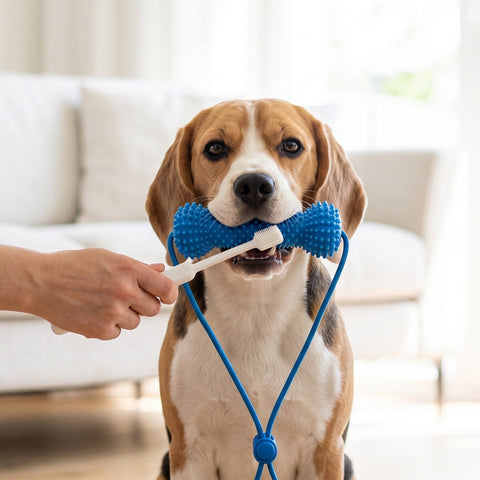
Spiky Dog Chew Ring with Squeaker
A soft open ring covered in short blunt spikes, with a squeaker and a whistle opening, in 4 inch and 5 inch sizes.
This ring is a play toy rather than an indestructible chew. Choose the size by your dog, stay with them while they play, and take it away once the spikes are worn down or a piece could come off.
Rope toys suit tug and carrying, and the braid gives teeth something to work against. The main risk is strands: dogs who shred rope can swallow long fibers, which can cause a serious intestinal blockage. Keep rope toys for supervised play and retire them as soon as they start to unravel.

Braided Carrot Rope Dog Toy for Tugging and Chewing
A carrot braided from linen rope with a green tassel top, 22 cm long and 3 cm across, for tug, chewing and fetch.
Plush toys are best for gentle dogs who carry and cuddle rather than destroy. For choosing and using them safely, see our guide to squeaky plush dog toys.
Chew toys for teething puppies
Puppies explore with their mouths, and teething adds to the urge to chew. Puppies typically start losing their baby teeth at around 12 to 16 weeks, and most have their full set of adult teeth by about six months of age.
- Choose softer toys during teething, and avoid very hard chews while the adult teeth come through.
- Offer a few textures, such as a soft rubber toy and a rope toy, and see which your puppy prefers.
- Redirect, don't scold. When your puppy chews hands or furniture, calmly swap in a toy and praise them for chewing it.
- Size up as they grow. A toy that suited a small puppy may be too small a few months later.
Some puppies find teething sore. If your puppy seems in pain or a baby tooth stays in place alongside an adult tooth, ask your veterinarian to take a look.
Supervision and when to replace a toy
Stay with your dog the first few times they use any new toy, so you can see how they chew it. Once you know a toy holds up, keep checking it before each play session.
Replace a toy when:
- It has cracks, tears, holes or loose pieces.
- A rope toy is fraying or unraveling.
- Stuffing or a squeaker is showing.
- It has worn down small enough to fit in your dog's mouth.
Contact your veterinarian if your dog has a chipped or broken tooth, bleeding gums, drools more than usual or seems reluctant to chew. If you think your dog has swallowed part of a toy, or they vomit, stop eating, seem lethargic or strain to pass stool after chewing, call your vet promptly and don't try to make them vomit unless your vet advises it.
Frequently asked questions
What is the thumbnail test for dog chews?
Press your thumbnail firmly into the toy. If it leaves a slight dent, the toy is less likely to be hard enough to break a tooth. If it leaves no mark at all, choose something softer. Combine it with a bend test, since a suitable chew should flex a little.
Are rope toys safe for dogs?
Rope toys can be a good choice for tug and supervised chewing. The risk comes when a dog shreds the rope and swallows strands, which can cause an intestinal blockage. Supervise play and replace rope toys as soon as they begin to fray.
What size chew toy should I buy?
Choose a toy wider than your dog's mouth so it cannot be swallowed or slip into the throat. If your dog is between sizes or is a strong chewer, pick the larger size, and replace toys that wear down.
Are there indestructible dog toys?
No toy is truly indestructible. Some are tougher than others, but a determined chewer can damage almost anything over time. Treat every toy as something to check and eventually replace.
What chew toys are best for puppies?
Softer rubber toys and rope toys sized for your puppy are a sensible start. Avoid very hard chews while adult teeth come in, supervise play, and move up a size as your puppy grows.
Find the right chew
Browse rings, ropes and tug toys for every size of dog, then pick one that suits how yours plays.