








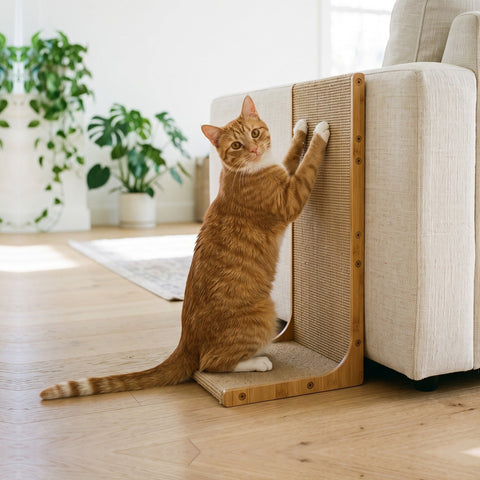
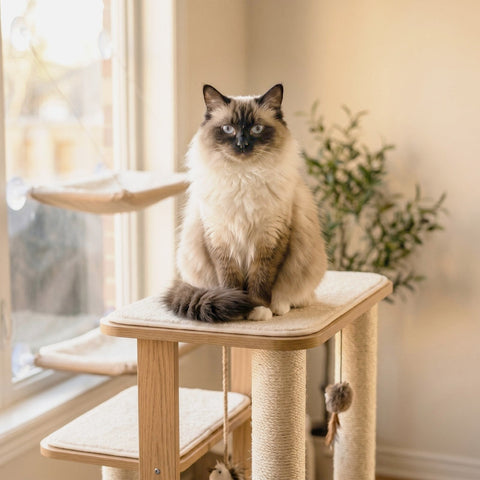



The most reliable way to stop a cat scratching furniture, from the couch to chairs and door frames, is to redirect the habit rather than fight it. Put an appealing scratching surface right where she already scratches, make the furniture less rewarding for a few weeks, and praise her every time she chooses the new spot.
Key takeaways
- Scratching is normal cat behavior. The goal is to move it, not stop it.
- Place the new surface directly beside the damaged spot and match the direction she scratches in, whether upright or flat.
- Pair a temporary furniture cover with praise, play and treats on the new surface, and be patient for two to four weeks.
In this guide
Why do cats scratch furniture?
Scratching is not bad behavior. It is how cats shed the worn outer layer of their claws, stretch the muscles along their back and shoulders, and leave both a visible mark and a scent mark from glands in their paws. It also releases energy, which is why many cats scratch right after waking up or when someone comes home.
The couch is simply a very good scratching surface. It is sturdy, it does not slide, it sits in a room that smells of the people she loves, and the fabric gives a satisfying pull. Once you see it that way, the solution becomes clear: offer something that ticks the same boxes and sits in the same place.
Read the damage before you buy anything
Your couch is already telling you what your cat wants. Spend a minute looking at the marks before you choose a scratcher.
- Vertical scratches up the arm or the side: she likes to stretch upward. A tall, stable post or a wall-mounted board suits her.
- Damage along the base or the front edge of the seat: she scratches low and long. A flat or angled surface on the floor usually works better than a post.
- Pulled threads on the rug in front of the couch: she is a floor scratcher, and a horizontal mat is the most natural swap.
- Marks near a doorway or window: this is often territorial scratching. Put a scratcher at that exact spot.
| What you see | What she prefers | What to offer |
|---|---|---|
| Tall scratches on the couch arm | Upright stretch | Heavy post or tall board that will not wobble |
| Frayed seat edge or skirt | Low, long pull | Angled board or flat mat at the base |
| Pulled rug or carpet fibers | Flat, full-body stretch | Large horizontal scratching mat |
| Scratching at room entrances | Marking territory | Any scratcher placed at the doorway |
A four-step plan to redirect scratching
When people ask how to stop a cat scratching furniture, the answer is rarely a single product. Most cats switch within a few weeks when these steps are done together. Doing only one of them, such as buying a scratcher and placing it across the room, is the most common reason the plan fails.
1. Put the new surface right beside the damage
Location matters more than the scratcher itself. Place it touching the part of the couch she uses most, even if it is not where you would ideally like it. Once the habit has moved, you can shift it a few inches every couple of days toward a better spot.
2. Make the furniture less appealing for now
Cover the favorite area with a thick throw, a fitted cover or double-sided tape made for furniture. The aim is to make the old spot feel different for a few weeks, not to scare her. Test any tape on a hidden area first so it does not mark your upholstery.
3. Make the new surface rewarding
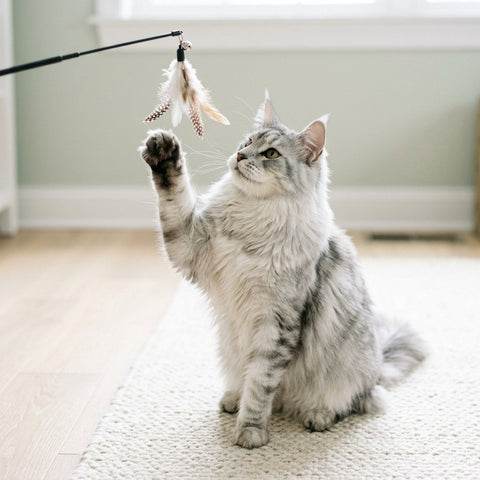
- Drag a wand toy slowly across it so she digs her claws in while playing.
- Sprinkle a little catnip or silvervine on it, if your cat responds to either.
- Offer praise or a small treat the moment she scratches it.
- Scratch it lightly with your own fingers when she is watching. Curiosity often does the rest.
4. Keep claws comfortable and be patient
Trimming just the sharp tips every couple of weeks reduces snagging and damage while the new habit forms. If you are unsure how far to trim, ask your veterinarian or a groomer to show you. Expect a few relapses in the first weeks, and calmly lift her onto the new surface when it happens.
When a flat scratching mat is the right answer
Many owners buy a post and are surprised when it gets ignored. Often the reason is simple: the cat was never scratching upward. If she is working the base of the couch, the rug in front of it, or stretching flat along the floor, a horizontal surface is a much closer match to what she already does.
A good floor scratcher needs three things. It should grip the floor so it does not slide when she pulls, it should be large enough for a full-body stretch, and the edges should hold together under repeated clawing. Size is worth getting right, because a mat that is too small gets ignored in favor of the couch right next to it.

Sisal Cat Scratching Mat for Indoor Cats
A flat, sisal-look faux hemp weave with a locked stitched edge and a non-slip backing, made in three sizes from a corner mat to a doorway rug.
To size a sisal scratching mat, measure the patch of floor beside the couch arm she has claimed and choose the size that covers it. This one comes in small (40 x 60 cm), medium (50 x 80 cm) and large (100 x 150 cm). The small suits a single corner, while the large can run the full length of the seat front. Because the surface can be vacuumed or rinsed and left to dry flat, it can stay down permanently rather than being moved every time it gets dusty.
What to avoid
- Punishment: shouting, spray bottles or clapping tend to make cats anxious, and anxious cats often scratch more, just when you are not in the room.
- A wobbly scratcher: if it tips or slides once, many cats will not try it again.
- Moving the scratcher too soon: wait until she uses it reliably before relocating it.
- Removing the only scratching outlet: covering the couch without offering an alternative just moves the problem to another piece of furniture.
A sudden increase in scratching, or scratching combined with changes in appetite, litter habits or hiding, can be a sign of stress or discomfort. If you notice this, check with your veterinarian. Speak to your vet as well before considering nail caps or any procedure.
Frequently asked questions
How long does it take to stop a cat scratching furniture?
Many cats begin using a well-placed scratcher within a few days, but a settled habit usually takes two to four weeks. Keep the furniture covered and the new surface right beside it for that whole period, and only move things once she chooses the scratcher on her own every time.
Do cats prefer vertical or horizontal scratchers?
It depends on the individual cat. Some love to stretch upward, while others scratch flat along rugs and the base of furniture. The simplest test is to look at where your couch is damaged, then offer a surface that matches that height and angle. Many homes do best with one of each.
Does double-sided tape stop cats scratching furniture?
It can help as a short-term deterrent because many cats dislike the sticky feel on their paws. It works best alongside an attractive scratcher placed right next to the taped area. Test the tape on a hidden spot first, and remove it once the new habit is reliably in place.
Why does my cat scratch the couch right in front of me?
Scratching is partly a social signal, so many cats scratch when their people are around, especially after waking or when you come home. It is rarely about spite. Use those moments to invite her to the new surface with a wand toy, then praise her when she uses it.
Should I trim my cat's nails to stop scratching?
Trimming will not stop the urge to scratch, because scratching is about stretching and marking as well as claw care. It does reduce snagging and damage while you redirect the habit. Trim only the sharp tip, and ask your veterinarian to show you how if you have not done it before.
Give her a better place to scratch
Explore posts, boards and mats designed to take the pressure off your furniture.