




To buckle up a dog safely in the car, put them in a well-fitted body harness, seat them in the back, and clip a short tether from the harness to a headrest or a seat belt buckle. Set the length so your dog can sit and lie down but cannot reach the front seats or slide into the footwell.
Key takeaways
- Always clip a car tether to a harness, never to a collar, so any sudden stop pulls across the chest rather than the neck.
- The back seat is the right place for a dog. Front airbags are designed for adult humans, not pets.
- Keep the tether short, plan a break every two to three hours on long drives, and never leave your dog alone in a parked car.
In this guide
Why is a loose dog a risk in the car?
A dog moving freely around the car is a distraction you cannot fully watch while driving. They may climb into your lap, get under the pedals or lean between the front seats at the moment you need to concentrate. In a hard stop, an unrestrained dog can also be thrown forward, which puts them and everyone else in the car at risk.
In the UK, Rule 57 of the Highway Code asks drivers to make sure dogs are suitably restrained so they cannot distract you or injure you or themselves if you stop quickly, and it names a seat belt harness, pet carrier, dog cage or dog guard as ways to do it. Rules vary elsewhere, but a calm, secured dog makes for a safer drive anywhere.
Headrest vs buckle-style dog seat belts
Dog seat belts, also called car tethers, come in two main styles. Both clip to your dog's harness at one end. The difference is where they anchor in the car.
| Feature | Headrest style | Buckle style |
|---|---|---|
| Anchor point | Loops around the headrest posts | Clips into the seat belt buckle |
| Fit check | Needs removable headrests with exposed posts | Clip must match your car's buckle |
| Anchor height | High, at head level | Low, at seat level |
| Moving between cars | Quick to loop on and off | Clip in and out in seconds |
| Good choice when | Your buckles are hard to reach or non-standard | You want the anchor low and close to the seat |

Headrest Dog Seat Belt with Swivel Clip
A nylon strap that loops around the headrest posts and adjusts from 18 to 30 in (46 to 76 cm), with lockable buckles and a zinc alloy hook that swivels a full circle.
The swivel hook lets your dog turn and lie down without the strap winding into a knot, and the strap unclips to double as a leash at a rest stop. It fits over standard headrest posts in cars and SUVs.

Dog Seat Belt for Car with Elastic Bungee
A braided nylon tether with reflective stitching, a sliding length adjuster, an elastic bungee section and a stainless steel clip that fits standard seat belt buckles.
The bungee section is designed to stretch a little so a sudden stop feels like a pull rather than a jolt. The clip measures 0.83 in (2 cm) wide, and a few car makes use non-standard buckles, so check yours before you order.
Why the tether goes on a harness
A collar concentrates any force on one small area of the neck. In a sudden stop, that is exactly where a car tether would pull. A body harness spreads the load across the chest and shoulders, which are far better able to take it. Clip the tether to the back ring of a snug, well-fitted harness, and check the fit before each trip: you should be able to slide two fingers flat under the straps, and no more.
Keep a collar with up-to-date ID tags on your dog while traveling. Just do not attach anything to it in the car.
Back seat, airbags and where your dog sits
The back seat is the right place for a dog. Front airbags deploy with great force and are designed around adult human passengers, so a dog in the front passenger seat is in the wrong position if one goes off. A dog in the front is also more likely to distract you.
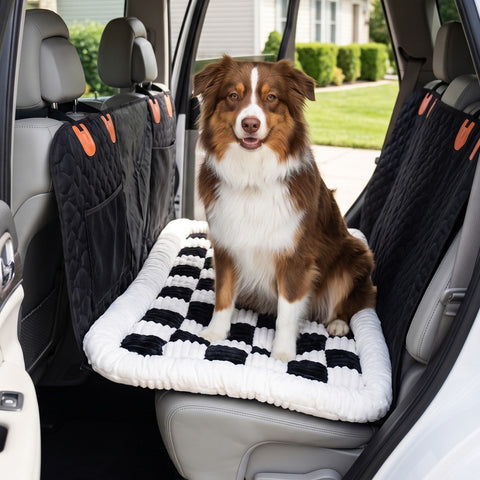
In the back, choose a seat position where the tether keeps your dog on the seat itself. If you use a seat cover, make sure it does not hide the buckle or block the tether.
How to set up a dog seat belt, step by step
- Fit your dog's harness indoors and check it with the two-finger test.
- Anchor the tether in the back seat, either looped around the headrest posts or clipped into the buckle until it clicks.
- Invite your dog onto the seat and clip the tether's hook to the harness back ring.
- Adjust the length so your dog can sit up, turn and lie down comfortably.
- Check they cannot reach the front seats, get their head out of an open window or slide off the seat into the footwell. If they can, shorten the tether.
- Give a treat once they settle, and start with short, easy drives if your dog is new to it.
Too long a tether defeats the purpose, because your dog can still build up speed before it stops them. Too short and they cannot lie down, which makes for a restless ride. Aim for the shortest length that still lets them get comfortable.
Breaks and comfort on long drives
On longer trips, animal welfare groups suggest stopping at least every two to three hours so your dog can stretch, drink and relieve themselves. Unclip the tether from the harness only once you have a leash attached, and only when you are safely away from traffic.
Never leave your dog alone in a parked car, even with the windows open or in the shade. Four Paws notes that on a 68°F (20°C) day, the inside of a car can reach about 86°F (30°C) within 10 minutes. Bring water and a bowl, and feed a light meal a few hours before a long drive rather than just before you leave.
If your dog drools heavily, whines, yawns repeatedly or vomits in the car, they may be experiencing motion sickness or travel anxiety. Speak to your veterinarian before a long trip, as they can suggest ways to help.
A note on crash testing
Most dog seat belts are travel restraints. They are designed to keep your dog on the seat and out of the driver's space, not to meet a vehicle safety standard. Independent crash testing for pet restraints does exist, for example through the Center for Pet Safety certification program in the US, but only a small number of products go through it. The two tethers above are travel restraints and are not crash-tested safety devices. If crash performance matters most to you, look for independent certification.
If you often travel with your dog on foot as well, our guide to the hands-free dog leash covers the walking side of the trip.
Frequently asked questions
Can I attach a dog seat belt to my dog's collar?
No. A collar puts all the force of a sudden stop on your dog's neck. Always clip a car tether to the back ring of a well-fitted body harness, which spreads the load across the chest and shoulders.
How long should a dog seat belt be?
Long enough for your dog to sit, turn and lie down, and short enough that they cannot reach the front seats, lean out of a window or fall into the footwell. Adjust it with your dog on the seat, then check it again as they settle.
Is it safe for a dog to ride in the front seat?
The back seat is the better choice. Front airbags are designed for adult humans and deploy with great force, and a dog in the front is more likely to distract the driver.
Does a buckle-style dog seat belt fit every car?
Most cars use a standard seat belt buckle, but not all. Check the width and shape of the clip against your car's buckle before buying. If your buckles are non-standard or hard to reach, a headrest-style tether is a practical alternative.
Are dog seat belts crash tested?
Some are, but most are not. Independent programs such as the Center for Pet Safety certify a limited number of restraints. Check the product information, and do not assume a tether is crash-tested unless it clearly says so.
Make every drive a calmer one
Find seat belts, carriers and travel essentials for dogs who ride along.


